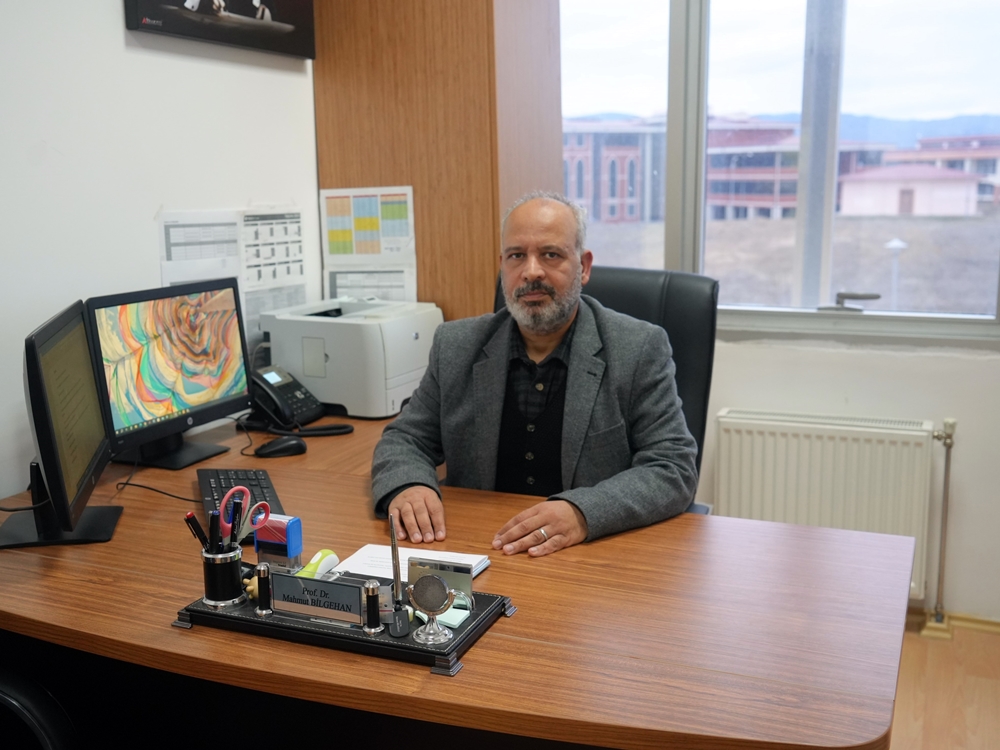
In an interview with İhlas News Agency, Prof. Dr. Mahmut Bilgehan, a faculty member of the Department of Civil Engineering at the Faculty of Engineering and Architecture of our University, gave warnings about the earthquake after his studies within the framework of the project titled "Lessons Learned from the February 6, 2023 Kahramanmaraş Earthquakes and Our Country's Preparedness for New Earthquakes" prepared after the earthquakes centered in Kahramanmaraş.
After the February 6 earthquake, Prof. Dr. Mahmut Bilgehan, a faculty member of the Faculty of Engineering and Architecture, Department of Civil Engineering, who went to the region and made investigations, stated that they had the opportunity to identify the problems in old and new buildings by stating that they went to the region and made investigations 1 month after the earthquake. Prof. Dr. Bilgehan said the following about the building quality in the earthquake zone: "Our problem is generally the buildings built before 2000. Since these buildings were not very well built, they collapsed very easily because they were poorly built. Buildings built after 2000 can collapse, but it is not very common. There were new buildings we examined, we observed the cracks in them, and there was no collapse that we can call very serious."
TOKI buildings have solid ground
After the 1999 Gölcük earthquake, Prof. Dr. Bilgehan evaluated the renewed building regulation and underlined that the current regulation is in world standards and in the style of the regulation used in Japan. Prof. Dr. Bilgehan stated that the problem here is the problem of reflecting this regulation to the field in an appropriate way and said that there are serious deficiencies in practice. Prof. Dr. Bilgehan stated that good buildings can be produced when the projects are properly reflected on the field and thus earthquake-resistant cities can be built.
Prof. Dr. Bilgehan said that no serious problems were observed in the buildings constructed by the Housing Development Administration (TOKİ) during the examinations and pointed out that the reason for this was that TOKİ buildings were built on solid ground and ground surveys were very well implemented.
Prof. Dr. Bilgehan said the following about TOKİ's buildings: "We see that ground surveys were not carried out in other buildings. That is to say, one of the reasons why TOKİ survived is that it was built on very good soils. The other reason, of course, is that it was built with tunnel formwork system. A different system was used there. It is made of reinforced concrete curtain structures all around. This makes TOKİ buildings strong and resistant to earthquakes."
Stating that there is a lack of ground surveys in Turkey, Prof. Dr. Bilgehan stated that special ground surveys should be made for each building and underlined that buildings are built on fault lines on bad soils. Prof. Dr. Bilgehan also said about Hatay: "We look at a city, that city is built entirely on alluvial soil. When it is built on alluvial soil, when an earthquake comes, it will easily destroy those buildings. Therefore, we need to build our buildings on suitable grounds."
Negligence in the earthquake zone is great
Prof. Dr. Bilgehan stated that he witnessed great negligence in the aftermath of the earthquake and said that electrical installations were laid by breaking the columns and beams, which is common in old buildings, and that this is also done in new buildings. Prof. Dr. Bilgehan stated that after 100 thousand people died in the earthquake in Japan in 1923, great transformations were experienced in the field of construction in Japan and said, "Japan is reaping the fruits of this success. While constructing a building, they are subject to very strict rules both in terms of occupancy and the legislation on the construction of the building. Because of these rules, there is not much destruction of any building during an earthquake."
Stating that they have determined that the buildings with basement floors in the earthquake zone are less damaged by the earthquake, Prof. Dr. Bilgehan said that the basement floor should be given importance and that the basement floor both increases the depth of the foundation from the ground and when the perimeter of the basement floor is equipped with curtains, that is, when curtain walls are built around the beams, that building will be more resistant to earthquakes. Prof. Dr. Bilgehan also said, "Reinforced concrete shear walls have a great contribution in taking the earthquake effect and shear forces. You can create a building only with columns, but there must be shear walls in terms of earthquake resistance."