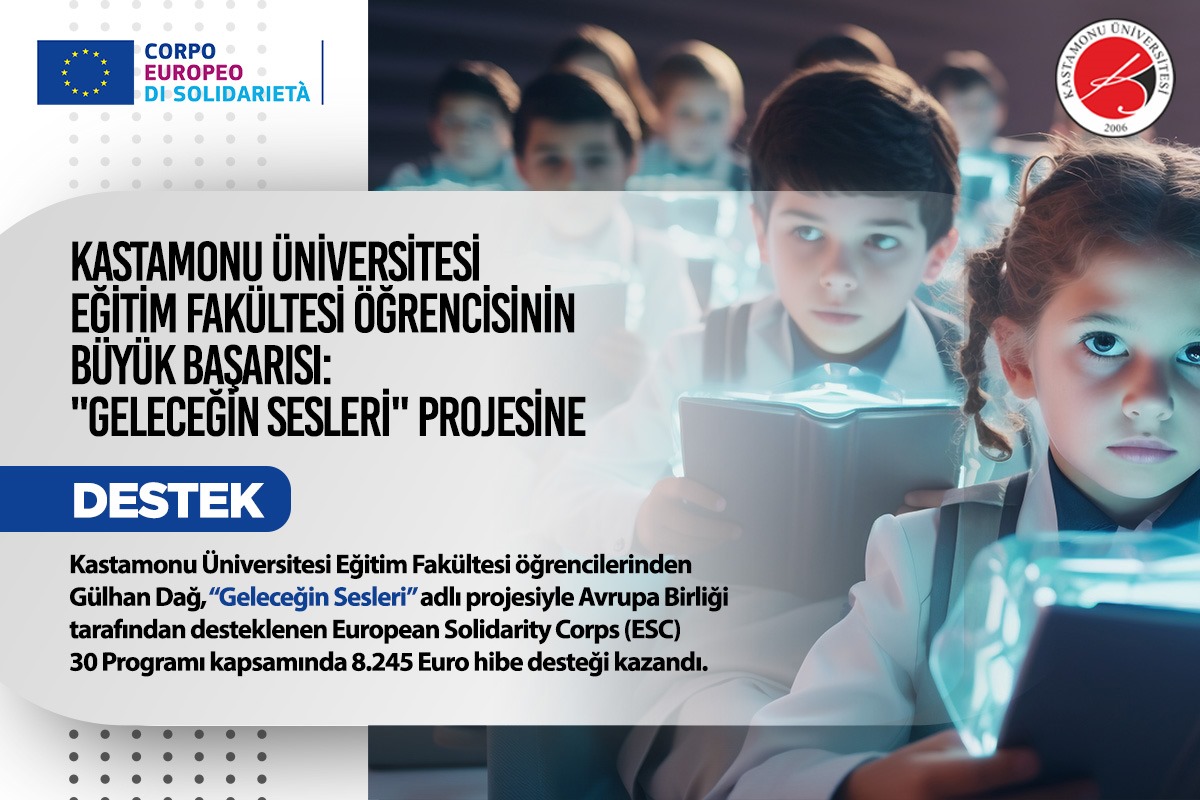
Gülhan Dağ, a student of Kastamonu University Faculty of Education, won 8,245 Euro grant support within the scope of the European Solidarity Corps (ESC) 30 Programme supported by the European Union with her project 'Voices of the Future.'
The 'Voices of the Future' project was carried out under Assoc's supervision. Prof. Adem Yılmaz, supported by the Turkish National Agency, aims to support the educational processes of children with reading difficulties and to raise awareness of prospective teachers on this issue. It also aims to contribute to the quality of education locally and internationally.
Within the scope of the project, 20 students from the Faculty of Education will be taught innovative methods such as reading aloud and reading with music for children with reading difficulties. These methods will be applied to 300 primary school students aged 7-11 in pilot schools. In addition, it is aimed to raise awareness about international education standards by informing prospective teachers about PISA exams. In this way, future teachers will contribute to improving the quality of education at local and global levels. Consultant Assoc. Prof. Dr. Yılmaz will provide academic and mentoring support to the students during the project and help them overcome the difficulties they may encounter in the field.
The project will be implemented in Kastamonu Hat, ay, Adıyaman, and earthquake zones. The students will reinforce the culture of equal opportunity and solidarity in education through field studies in these regions. After the successful completion of the project, the results obtained will be reported and shared with the Ministry of National Education (MoNE) and the authorities of the Faculty of Education of our University. In addition, it aims to create a long-term impact by making the project materials available in digital environments.
Gülhan Dağ said in her statement about the project, 'As students of the Faculty of Education, we want to find solutions to children's reading and comprehension difficulties. The methods we have developed to meet international standards will make a difference for prospective teachers and children.'